Fifteen Per Cent: Yemen's Hunger Crisis and the Aid That Never Arrived
More than 18 million Yemenis face acute hunger. The humanitarian appeal is less than 15 percent funded. On June 16, 2026, the UN Security Council heard what that number means in practice: children going untreated, communities cut off, a response forced to choose who to leave behind.
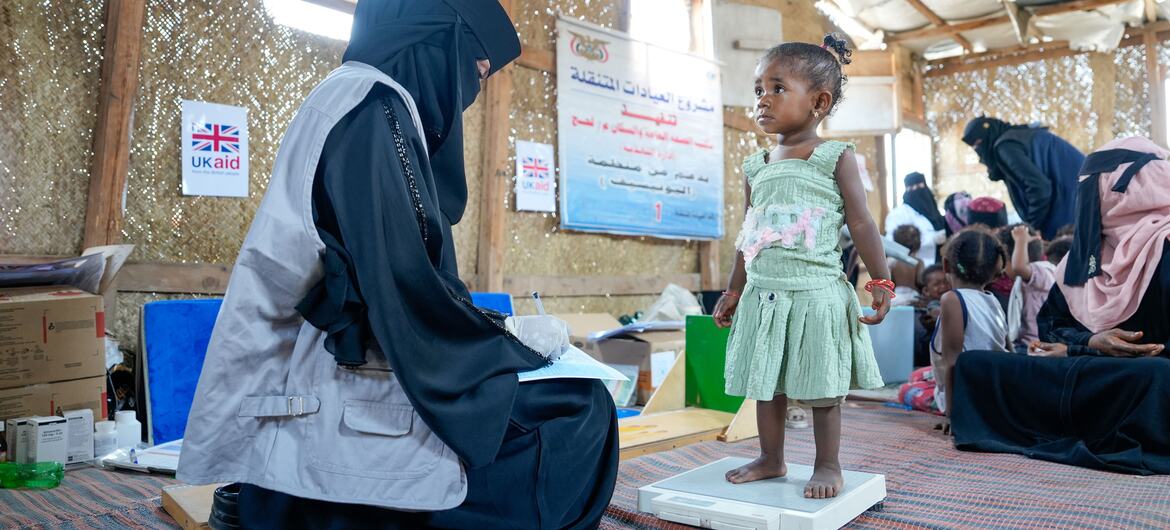
© UNICEF Yemen, June 2026. Dr. Zahra screens 18-month-old Rana for malnutrition at the Al-Atira IDP camp in Lahj Governorate.
On the morning of June 16, 2026, UN relief chief Tom Fletcher stood before the Security Council and delivered a phrase that has become the most precise summary of Yemen's crisis in years: "Every funding cut has a human cost — a missed meal, untreated malnutrition, a community cut off from help."
The numbers behind that sentence have been accumulating for months. More than 18 million Yemenis — over half the country's population of 35 million — are acutely food insecure. Around 2.2 million children under the age of five are acutely malnourished. More than 500,000 of them suffer from severe acute malnutrition (SAM), the life-threatening end of a spectrum that kills quickly and quietly. The 2026 humanitarian appeal, which requests $2.16 billion to reach 12 million people, is less than 15 percent funded. That is not a slow-moving crisis. It is a deliberate choice, played out in budget lines and bilateral decisions, whose consequences fall on the most vulnerable people in one of the world's most devastated countries.
Eleven Years, One Arithmetic
Yemen's crisis began in earnest in 2015, when the Saudi-led coalition intervened against the Houthi movement that had seized the capital, Sanaa. What followed was more than a decade of airstrikes, sieges, blockades, economic collapse, and displacement. A 2022 truce between the Houthi rebels and the internationally recognised government created a fragile reduction in hostilities that has broadly held. But as UN Special Envoy Hans Grundberg told the Security Council on June 16, "the conflict is unresolved." Front lines are entrenched. Resources continue to be drained. In some areas, teachers and students have joined armed groups simply because that is the only available salary.
The truce bought time. It did not buy stability. And the humanitarian system that was supposed to use that time to scale up has instead been forced to scale back — not because needs declined, but because funding did.
The Funding Collapse
The figures are staggering. Yemen's 2025 Humanitarian Needs and Response Plan received just 28 percent of required funding — the lowest since the crisis escalated. Contributions to the World Food Programme (WFP) dropped by more than 70 percent between 2024 and 2025. In the United States, the Trump administration's sweeping review of foreign aid resulted in the cancellation of 83 percent of USAID programs by March 2026, including $107 million in Yemen-focused interventions. That single decision ended food assistance for 2.4 million people through WFP and stopped nutritional care for 100,000 children.
The consequences are now structural. More than 450 health facilities across Yemen's 22 governorates have closed since the start of 2025. Over 2,800 lifesaving nutrition services — nearly half of all active programs — have shut down. Therapeutic feeding centres that once treated children with SAM are no longer operating in many districts. Admissions for severe malnutrition have dropped, but not because fewer children need care. It is because there is nowhere left for them to go.
UN Security Council Briefing — Yemen, 16 June 2026 (UN News)
WFP / FAO / UNICEF: "Nearly half of the population in Government-controlled areas of Yemen face acute food insecurity," 3 June 2026 (WFP)
UNICEF: "Acute malnutrition surges in Government of Yemen-controlled areas," 2026 (UNICEF)
OCHA Yemen Humanitarian Needs and Response Plan 2026 (OCHA)
What 15 Percent Funded Means in Practice
When OCHA says the humanitarian appeal is less than 15 percent funded, it is not describing a gap that can be papered over with goodwill. It means that, across every sector — food, nutrition, health, WASH, protection — agencies must decide which areas to reach and which to abandon. In a country where 59 percent of health facilities are functional on a good day, where only 63 percent of children receive complete vaccination coverage, and where epidemic-prone diseases circulate constantly, the margin for error is zero.
The June 3 IPC analysis — a joint assessment by WFP, FAO, and UNICEF covering government-controlled areas of Yemen — found that around five million people are in IPC Phase 3 (crisis) or worse, including 1.5 million in Phase 4 (emergency). Famine conditions affecting more than 40,000 people are projected to emerge across four districts within weeks if no action is taken. In areas under Houthi control, WFP operations have remained suspended since September 2025 due to access constraints. Those populations receive no comparable assessment, which does not mean their situation is better — only that it is invisible.
Women and girls carry a disproportionate share of this invisibility. Yemen has 22 million people requiring humanitarian assistance. Half are women and girls. Two-thirds of women in need are of childbearing age, making reproductive health — maternal care, safe delivery, obstetric emergencies — central to the response. As funding has contracted, those services have contracted with it. In a June 12 report, UNFPA described Yemen's forgotten crisis within a crisis: a country where a woman's chance of surviving childbirth depends, increasingly, on which governorate she happens to live in and which NGO still has funding to reach her.
The Detention of Aid Workers
On top of funding shortfalls, Yemen's response operates under a specific and serious constraint: 73 UN personnel are currently held in arbitrary detention by Houthi rebels, many since 2024. Both Fletcher and Grundberg raised this at the Security Council. The UN Secretary-General has issued a formal statement; the Security Council passed a resolution earlier in June demanding their unconditional release. As of the June 16 briefing, none had been freed.
The detention of UN staff does more than harm individuals and their families. It constrains the institutional capacity of the response. Agencies cannot easily replace detained specialists. Operations that depend on those individuals — programming decisions, field coordination, monitoring — are disrupted. In a context where every operational gap translates to people unreached, this is a compounding crisis on top of a funding one.
A Political Problem with a Humanitarian Face
Tom Fletcher's three requests to the Security Council on June 16 were direct: secure the release of detained colleagues; fund the humanitarian response; and support a political process that can actually end the conflict. The third request is the most difficult and the most important.
Humanitarian action in Yemen is not failing because the responders are incompetent or the system is broken. It is failing because the underlying conflict remains unresolved, because major donors have retrenched, and because the political will to fund a sustained response has eroded alongside attention. The 2022 truce created conditions under which a well-funded response could have made meaningful progress. That opportunity is being foreclosed by underfunding, detention, and a political vacuum.
OCHA's crisis response director was on the ground in Yemen at the time of the Security Council briefing, hearing directly from communities: families in repeated cycles of displacement, children out of school, women and girls facing violence and deprivation, livelihoods destroyed by the triple pressure of conflict, floods, and drought. Local partners — Yemeni civil society organisations, community health workers, local NGOs — are absorbing as much of the response as they can. But local capacity cannot substitute for sustained international funding. It can extend reach; it cannot replace the resources that have been withdrawn.
The Number That Should Not Be Acceptable
Fifteen percent. That is the funding level for a response designed to reach people in acute hunger, severe malnutrition, and famine-like conditions. In absolute terms, the 2026 appeal needs $2.16 billion. The gap is approximately $1.84 billion. That figure sits alongside the record-level humanitarian underfunding documented across all crises in 2026 — a global environment in which donors are cutting budgets, retrenching from multilateral commitments, and directing resources toward domestic priorities.
For Yemenis, this is not an abstraction. The child who cannot access a therapeutic feeding centre because funding ran out is not a statistic waiting to be counted. The woman who cannot reach a functional health facility for delivery is not a programme gap to be managed. They are specific people, in specific places, experiencing a specific and preventable form of harm.
The Security Council was asked to act on June 16. The question that will determine outcomes in Yemen over the next six months is not whether the system knows what to do — it does — but whether the political will to fund what needs doing can be found before the situation moves from emergency to irreversible.
Yemen's crisis tests a specific claim that the humanitarian system has made for years: that early and sustained investment in response prevents worse outcomes and lower costs later. The data supports this claim. Preventing severe acute malnutrition is cheaper than treating it; treating it is cheaper than managing the mortality and long-term developmental consequences of untreated cases. The 15 percent funding figure is not a humanitarian failure. It is a political one. For practitioners and students of humanitarian action, Yemen in 2026 is a case study in what happens when the calculus of donor budgets disconnects from the calculus of human need — and what it costs when that gap is allowed to persist.